The Warning Sign You Shouldn't Ignore If your gums bleed slightly when you brush or floss, you might assume you are simply brushing a bit too hard. Many people treat "pink in the sink" as a normal occurrence—a minor annoyance easily rinsed away at the bathroom mirror. September is officially National Gum Care Month, a …
The Warning Sign You Shouldn’t Ignore
If your gums bleed slightly when you brush or floss, you might assume you are simply brushing a bit too hard. Many people treat “pink in the sink” as a normal occurrence—a minor annoyance easily rinsed away at the bathroom mirror.
September is officially National Gum Care Month, a dedicated time across the dental community to challenge this dangerous myth. Healthy gums should never bleed when cleaned, just as healthy skin shouldn’t bleed when washed.
Bleeding is the primary distress signal of your oral health. Because chronic gum issues are largely painless in their early stages, ignoring these subtle indicators allows a localized bacterial problem to quietly destroy tissues beneath the surface. Taking time this September to understand the reality of chronic infections is your best defense against structural damage and eventual tooth loss.
Section 1: The Destructive Path of Periodontal Disease
Understanding the progression of gum disease starts with recognizing how a surface-level issue transforms into a deep-rooted structural threat. Periodontal disease is not a static condition; it evolves through two distinct structural stages:
- Gingivitis (Early Stage): This is a surface-level, inflammatory reaction to built-up plaque bacteria along your gumline. The tissue becomes red, swollen, and tender to the touch. The good news? At this stage, the condition is completely reversible because the bacteria have not yet attacked the underlying bone.
- Periodontitis (Advanced Stage): If left unmanaged, the inflammation spreads deeper, transitioning into advanced periodontal disease. The bacteria migrate far beneath the visible gumline, forming deep, infected pockets. Your body’s own immune system overcompensates to fight the infection, accidentally destroying the specialized ligaments and alveolar jawbone structures that anchor your teeth in place. Once this bone is lost, it cannot naturally grow back.
An infection in your mouth does not stay in your mouth. The same harmful bacteria causing tissue destruction can easily enter your bloodstream through fragile, bleeding gums. Clinical data from major global health organizations directly links unmanaged chronic periodontal infections to elevated risks of cardiovascular disease, arterial clogging, and severe complications with blood sugar management in diabetic patients.
Section 2: Restoring Your Foundation — Advanced Gum Disease Treatment
Brushing and flossing at home are excellent preventative habits, but they cannot remove tartar (calculus) once it has hardened onto your root structures beneath the gumline. To halt the spread of infection, specialized, professional gum disease treatment is required.
Scaling and Root Planing (Deep Cleaning)
This foundational therapy is divided into two clear phases:
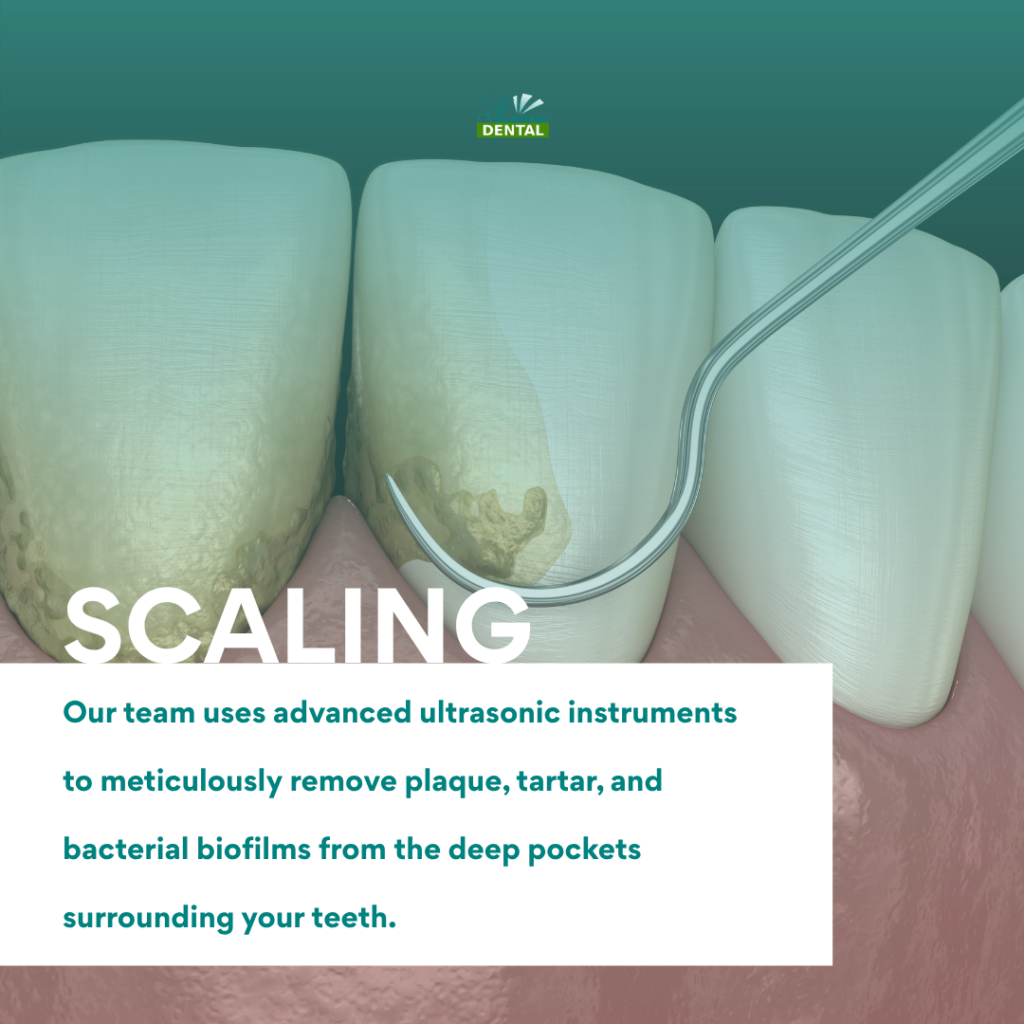
- Scaling: Our team uses advanced ultrasonic instruments to meticulously remove plaque, tartar, and bacterial biofilms from the deep pockets surrounding your teeth.
- Root Planing: We gently smooth out the rough microscopic surfaces of your tooth roots. By eliminating these rough zones, we destroy the physical hiding places where bacteria love to multiply, allowing your natural gum tissue to heal and reattach tightly to the clean tooth structure.
For localized, stubborn pockets of infection, we can also apply targeted antimicrobial medications directly into the tissue. This provides continuous, deep-level protection to sanitize the area and accelerate your body’s natural healing response.
Section 3: Comfort-Focused Care — A Gentle Dental Experience
We know that hearing terms like “deep cleaning” or “root planing” can spark immediate anxiety for many patients. Past experiences at cold, corporate medical clinics can leave you feeling hesitant about getting the care you need.
At Fairview Dental, we prove that managing your systemic health does not have to be an uncomfortable experience. We practice a true gentle dental philosophy. By using modern topical numbing gels, localized anesthetics, and ultra-fine ultrasonic scalers that vibrate at high speeds to break up debris, we minimize friction and keep you entirely relaxed throughout your visit.
High-Intent Periodontal Q&A
Can gum disease cause my teeth to move or loosen?
Yes, advanced periodontal disease is the single leading cause of tooth mobility and adult tooth loss. As the chronic infection systematically breaks down the jawbone holding your roots in place, the foundation crumbles. Teeth will gradually begin to shift out of alignment, develop gaps, or feel loose when you chew. Securing a professional evaluation early is the only way to stabilize the bone and save your natural smile.
How often do I need to come in after receiving gum disease treatment?
Once you complete a deep cleaning, your healing must be closely monitored. Most patients transition to a specialized “Periodontal Maintenance” schedule, coming into our office every 3 to 4 months instead of the standard 6-month window. This frequent interval is vital because aggressive periodontal bacteria can rebuild their colonies within 90 days, and consistent cleanings prevent them from causing a secondary infection.
Defend Your Smile From the Ground Up
Bleeding gums are never a minor issue—they are a clear call for help from your immune system. This National Gum Care Month, take control of your long-term health by differentiating between a surface-level issue and a deep-level structural threat. With modern interventions and a patient-first approach, stabilizing your smile is easier and more comfortable than ever.
Ready to stop the bleeding and protect your smile’s foundation? Fairview Dental combines a compassionate, gentle dental approach with state-of-the-art diagnostic equipment to keep your care completely stress-free. Contact our Brentwood office today to schedule your comprehensive periodontal health screening!